The search around Cygnus X-1 reached its second stage with 27 candidates: features in LIGO's data marked for closer examination. None survived follow-up. Yet the researchers could still use the result to argue against a range of particle masses—provided their account of the black hole's past was right.
The particles in question, ultralight vector bosons, remain hypothetical. If they exist, a spinning black hole could help make them conspicuous. Their field could draw energy from its rotation, grow into a cloud around it and radiate gravitational waves. An instrument on Earth would search for that collective disturbance, without having to catch an individual particle. The LIGO–Virgo–KAGRA collaboration tried this with three black holes, using LIGO data from the first part of its fourth observing run.
A signal powered by rotation
Rotation gives the proposed cloud something to live on. Under suitable conditions, the black hole transfers rotational energy to the field through a process called superradiance. As the field grows, the hole spins down.
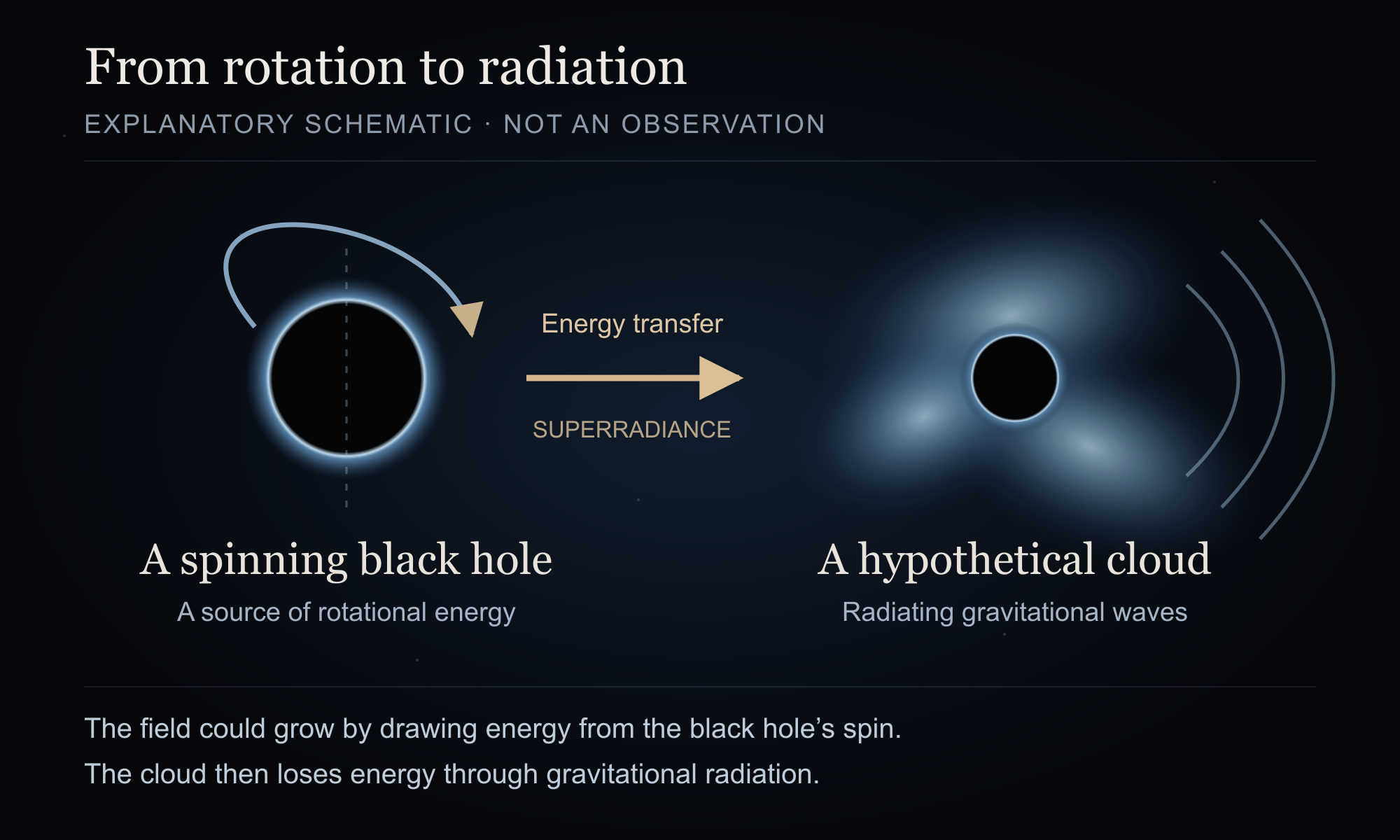
The resulting cloud would be an oscillating distribution, uneven around the rotation axis. In calculations by Nils Siemonsen and William E. East, it loses energy through gravitational radiation concentrated near a characteristic frequency. Such particles are possible dark-matter candidates; this particular search concerned the waves their clouds might emit.
To predict that signal, the calculation has to match a particle mass to a particular black hole, then follow the cloud that could grow around it. Siemonsen, Taillte May and East developed SuperRad, a model combining numerical and analytical calculations, to work out how strongly the cloud would radiate and how its frequency would evolve.
The waves have twice the cloud's oscillation frequency. That frequency also changes as radiation carries energy away and alters the cloud's own gravity. The cloud is spending the energy that makes it detectable, changing its signal as it does so. Particle mass helps locate the frequency to search; the cloud's evolution tells the researchers how that frequency should move.
Nearby, or newly born?
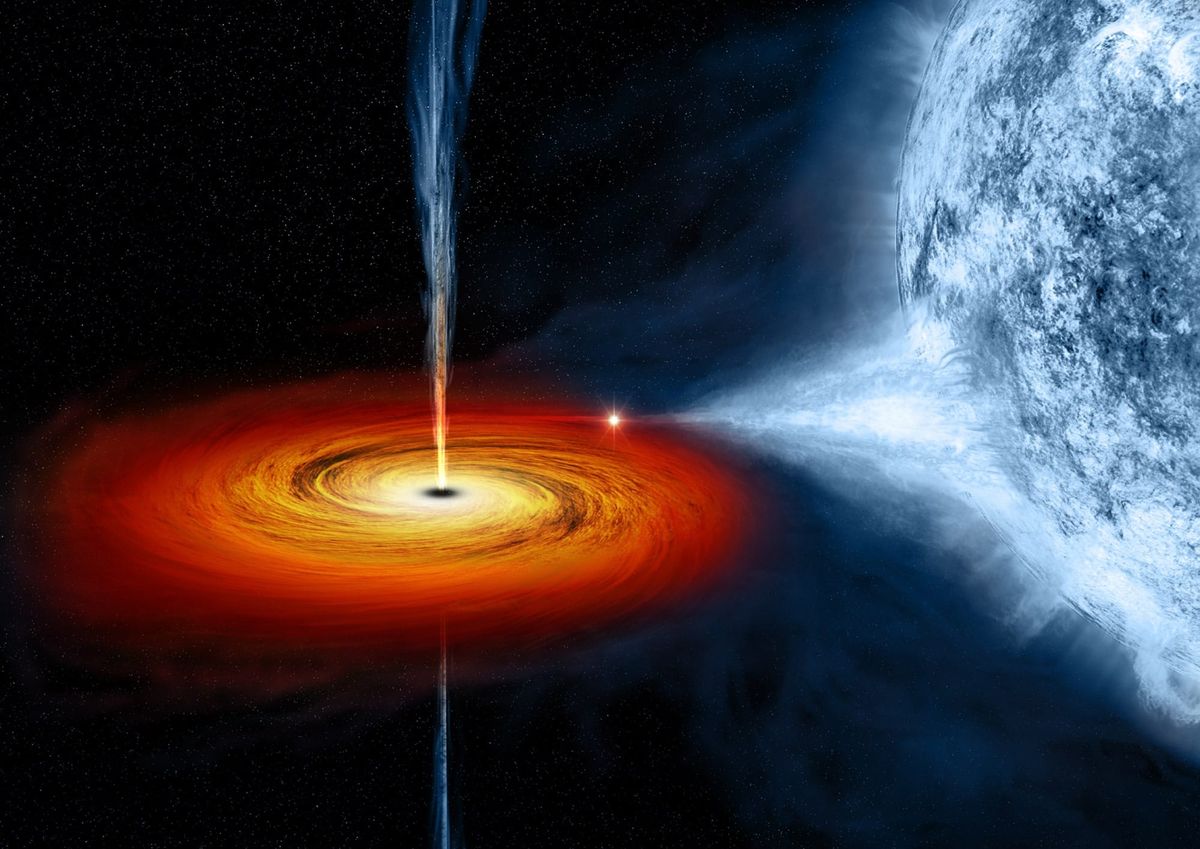
Cygnus X-1 lies roughly 7,000 light-years away. For this search, that counted as close. The other targets were the black holes left by two distant mergers, GW230814 and GW231123. Their merger signals supplied something Cygnus X-1 could not: an observed time of birth.
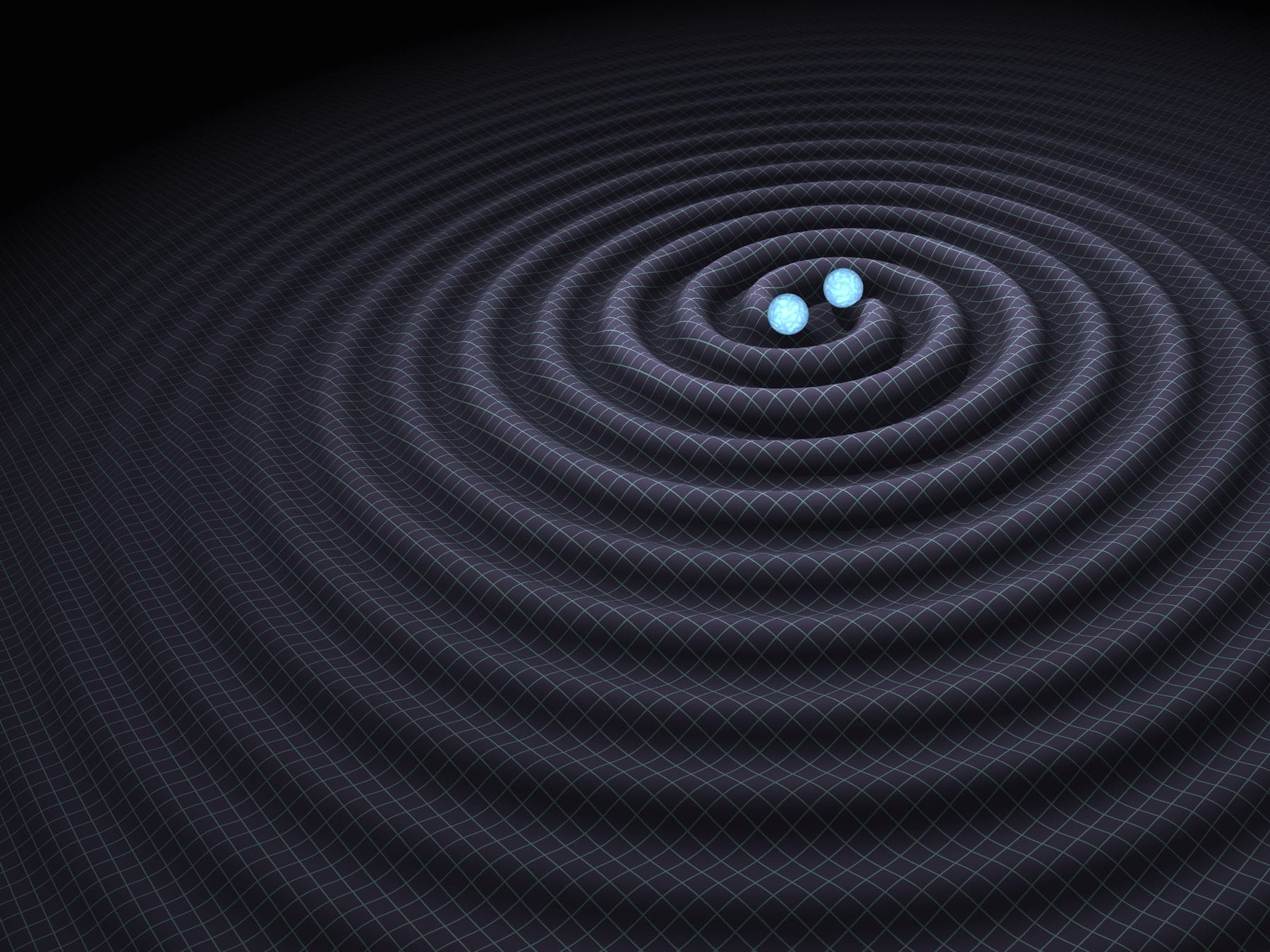
Knowing when the black hole formed gave the researchers a starting point for modeling a cloud's subsequent growth and radiation. Around these young remnants, the search tracked signals whose frequencies could change appreciably. A wave from a boson cloud would have to be found separately from the merger signal that announced the hole's formation.
For the older black hole in Cygnus X-1, the expected signal was steadier. Its motion around a companion would still shift the frequency arriving at Earth, and the search allowed for that binary motion.
The distant remnants yielded no high-confidence particle exclusions. The search around nearby Cygnus X-1 went further.
A limit with a past
With no cloud signal surviving the checks, the Cygnus X-1 search set an upper limit on the gravitational-wave amplitude: a bound on the wave strength compatible with the non-detection under the search procedure. No faint cloud had been measured. The team now had an observational limit to put beside the signal predicted by the model.
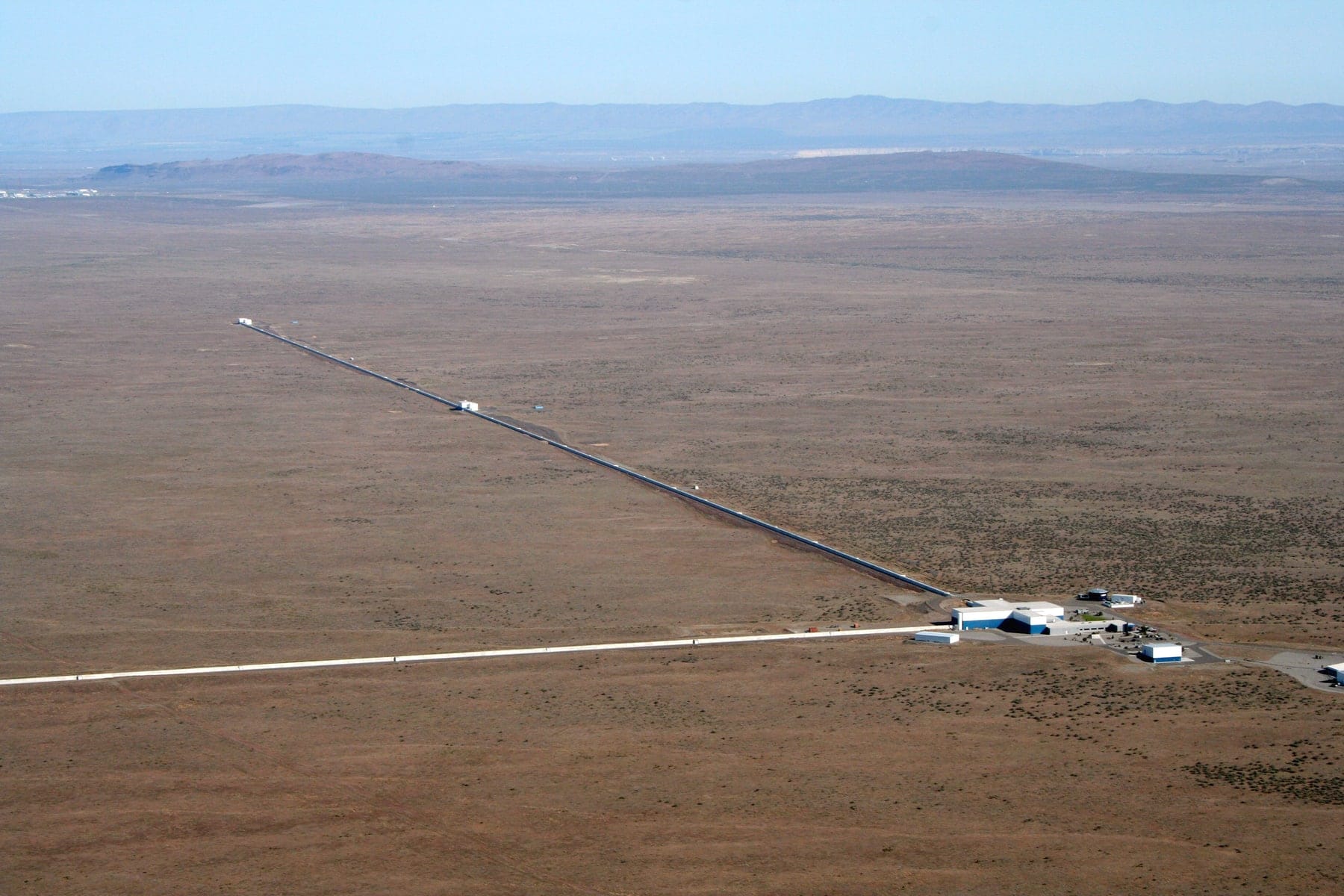
Suppose a particular particle mass should have produced a wave stronger than that limit. Its absence would count against that mass under the assumed conditions. If the prediction fell below the limit, the same search could leave it unexcluded. What mattered was how much the model gave the instruments to find.
The reported exclusion covered [0.85, 1.59] × 10⁻¹³ eV, apart from the narrow gap [1.44, 1.45] × 10⁻¹³ eV, at 95% confidence. It assumed an initial dimensionless black-hole spin, χᵢ, greater than 0.5, together with the adopted astrophysical estimates and interaction model. The confidence level describes the exclusion procedure, not a 95% probability that the particles do not exist.
The calculation adopted an age estimate of 6.2 ± 1.8 million years. A cloud could have grown and radiated away energy over that history; predicting today's wave required allowing for what it had already lost. The waveform model also left out additional interactions of the field with itself or with ordinary matter. Those could change the cloud's development, so the interval applies to the specified gravitational model.
Then there is the spin before the cloud. Since the cloud would feed on rotation, its predicted strength depends on how much rotational energy was available at the outset. The search did not measure that earlier spin. Lower that assumed spin and the predicted wave weakens. A particle mass excluded under the faster-spinning model may survive the slower one, although nothing in the detector data has changed.