Step outside a temple into full daylight and everything changes.
The quiet drama of shadow disappears. The details go sharp. Heat climbs up from stone. Even the colors look louder.
That’s the South in a sentence: growth, glare, movement.
And it’s exactly why Virūḍhaka, Protector of the South, rarely feels like a gentle guardian. He feels like a king stationed at the edge of a world that won’t stop expanding.
If you’re jumping in mid-series, here are the other posts to catch up on:
- Vaiśravaṇa - Protector of the North
- Dhṛtarāṣṭra - Protector of the East
- Virūpākṣa - Protector of the West
Now, let’s deal with the South.
His Name Sounds Peaceful. The Symbolism Isn’t.
Virūḍhaka is often linked to “increase” or “growth.”
So you’d expect vines, wheat, blessings, maybe a friendly smile.
Instead, he shows up armored, armed, and ready to stomp something into the floor.
That is the whole point.
Because real growth can be rough.
Growth breaks things. Growth pushes. Growth crowds out other life if no one keeps it in check.
Rolo’s Note: The South King is a great spiritual reminder that progress can look different from feeling calm. Sometimes progress looks like boundaries, discipline, and saying no to yourself.
Think of the South as a Pressure Zone
In the East, Dhṛtarāṣṭra guards the “beginning” energy, sunrise, harmony, vigilance.
In the North, Vaiśravaṇa’s story showed how protection can turn political, how a wealth deity becomes a war guardian when a society needs a war guardian.
Virūḍhaka’s South is a different kind of threat.
The threat is overflow rather than invasion.
The South is where things multiply.
- desires multiply,
- distractions multiply,
- conflicts multiply,
- and if you’re not careful… excuses multiply.
Virūḍhaka is the king who says: enough.
His Subjects Are Wild Company
Each Heavenly King rules over a class of beings in their direction.
Virūḍhaka’s are the kumbhāṇḍas, a group that tends to get described as strange, unruly, and more earthy than polished.
That’s fitting.
Because the South, symbolically, runs wild.
It’s the direction of life-force. The kind that grows wild. The kind that turns into a jungle if no one clears a path.
Virūḍhaka guards the edge of something that can become chaos just by doing what chaos does best: spreading.
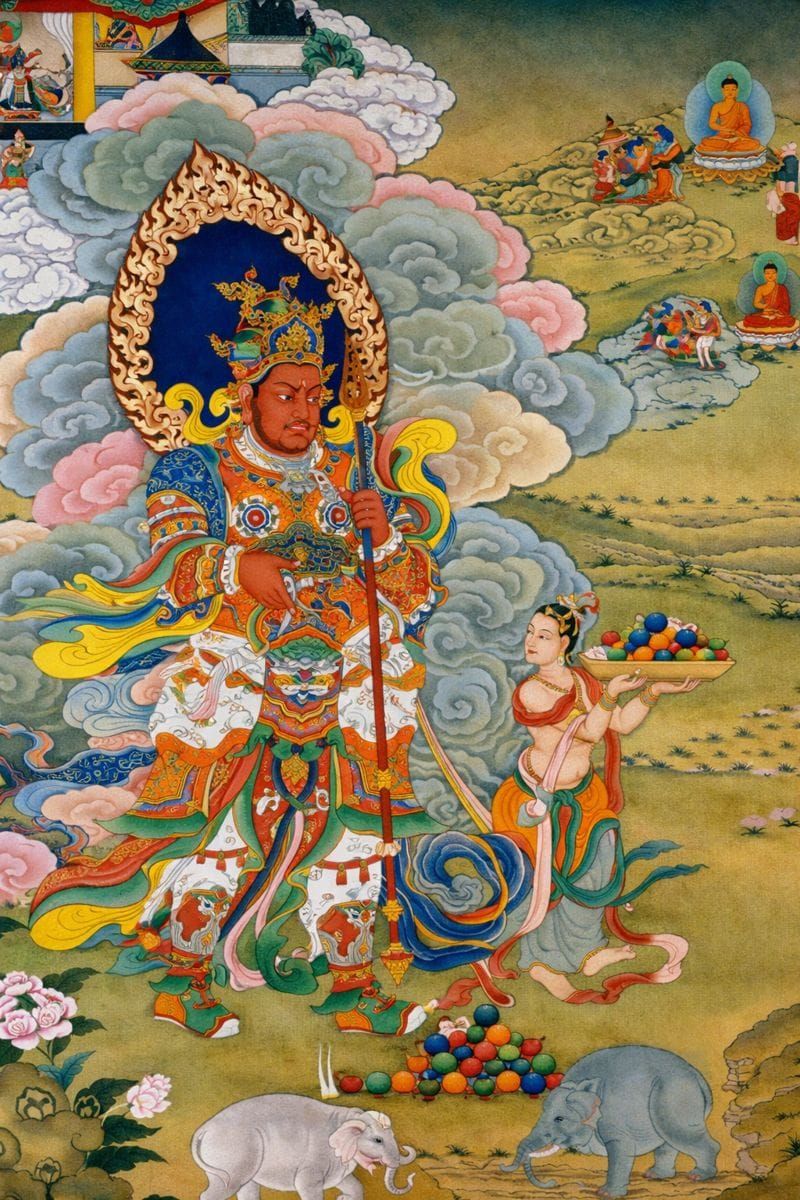
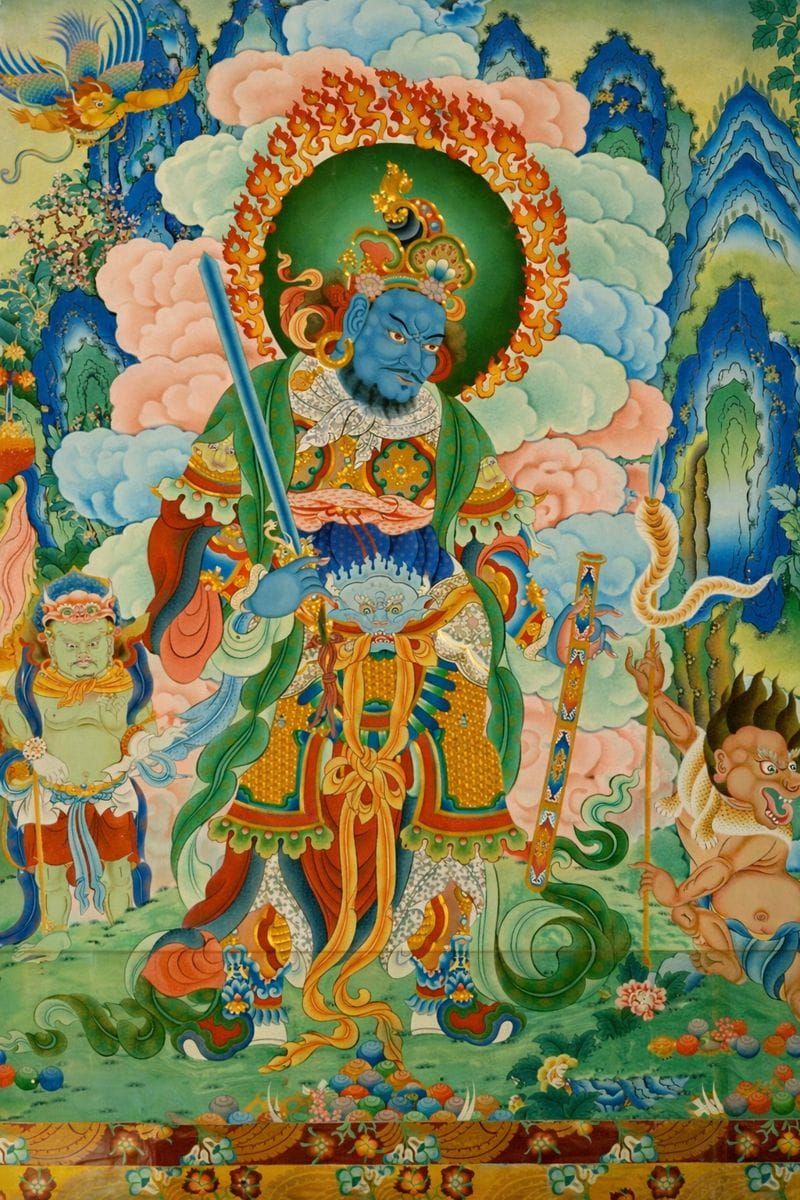
How to Spot the South King in Art
If you’ve ever looked at temple guardian statues and thought, “Okay… which furious guy is which?” you’re not alone.
Virūḍhaka often shows up with a few recognizable traits.
1) The warrior look
He’s usually armored, properly armored. The visual message is simple: he enforces the boundary.
2) A weapon that cuts the problem down to size
Depending on the tradition, you’ll see him with a sword, or a longer pole weapon (sometimes described as trident-like).
Either way, the symbolism is consistent.
Growth needs pruning.
Discipline needs something sharp.
3) The defeated figure underfoot
Like the other kings, Virūḍhaka is often depicted trampling a demon or chaotic spirit.
It’s dramatic, yes.
But it also tells you what kind of protection he represents: subduing and ending the threat.
And sometimes the “demon” is internal.
Sometimes the thing underfoot is the habit you keep feeding.
Sometimes it’s the impulse that keeps winning.
Sometimes it’s your own momentum.
Virūḍhaka’s whole posture says: you outgrow a problem by confronting it.
What the South King Teaches
You don’t have to believe in Mount Meru to get the lesson.
Virūḍhaka is basically the face of the part of life we try to avoid admitting:
- If you want change, you need structure.
- If you want improvement, you need limits.
- If you want “growth,” you will probably have to cut something off.
This is why the Four Heavenly Kings work so well as a set. Each one covers a different kind of protection:
- Dhṛtarāṣṭra reminds you that harmony is a discipline.
- Vaiśravaṇa reminds you that symbols change as cultures collide.
- Virūpākṣa reminds you that clarity is a defense against illusion.
- Virūḍhaka reminds you that growth without control becomes a problem.
He is the necessary king, and comfort is rarely his method.