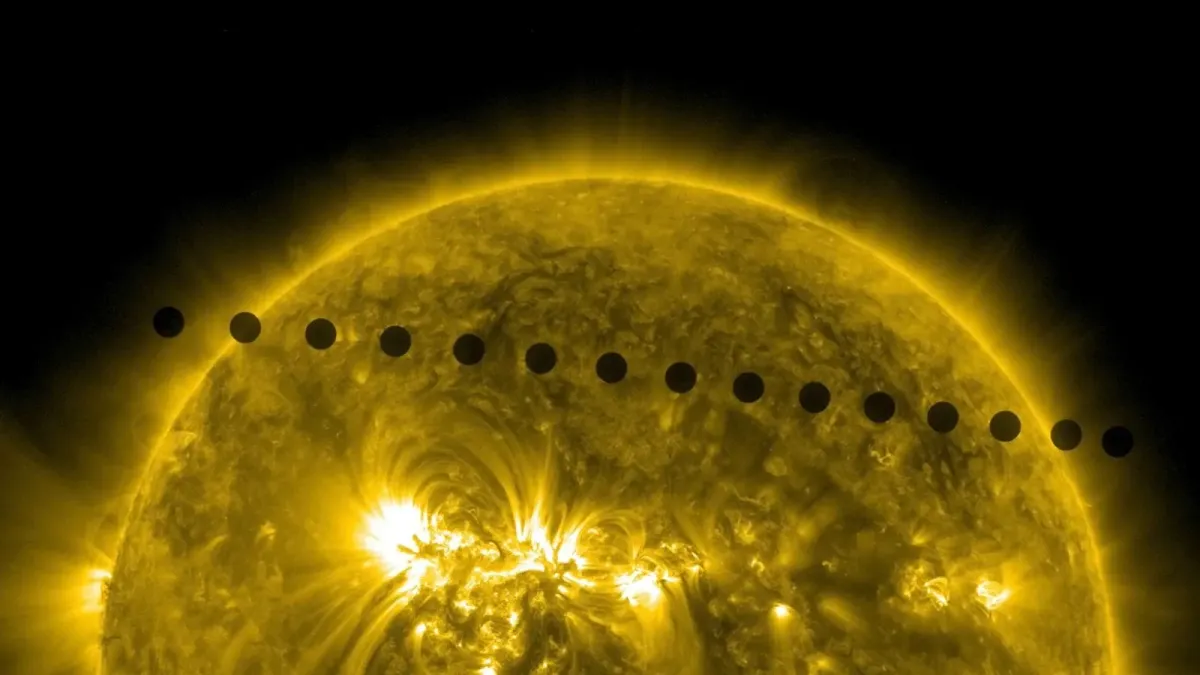
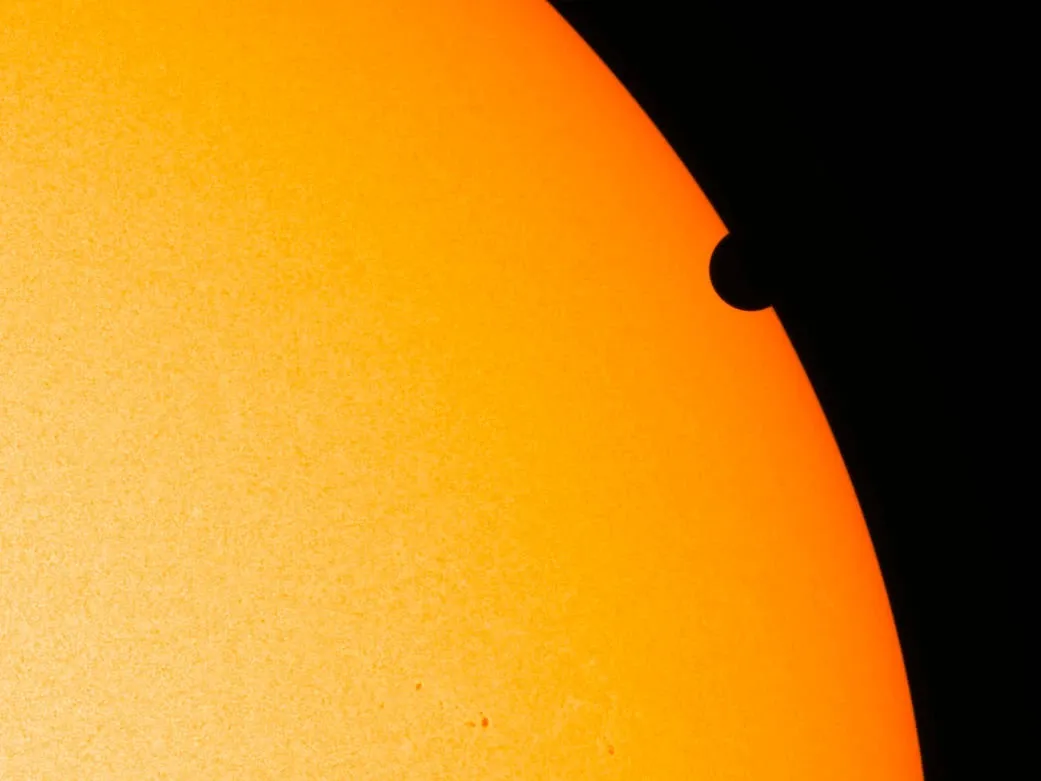
At second contact, Venus has just moved wholly inside the Sun's visible disk. Geometrically, the planet's outline and the solar edge touch at one point. An observer should be able to mark the time, then mark the corresponding internal contact as Venus approaches the other side. The calculation has a clean boundary. The image might not.
Observers of eighteenth-century transits encountered a dark connection between Venus and the darkness outside the Sun. Instead of separating neatly from the solar edge, the planet appeared to cling to it. This black-drop effect made a supposedly precise instant difficult to identify. Halley's method had promised timing to roughly one second. A historical and optical account describes uncertainties that could reach thirty seconds or a minute. The clock could keep running while the observer waited for the image to decide what counted as contact.
A time that stood for a distance
Kepler's third law connected planets' orbital periods to the relative sizes of their orbits. It supplied proportions. To turn those proportions into a physical scale, astronomers still needed a distance expressed in units they could measure on Earth.
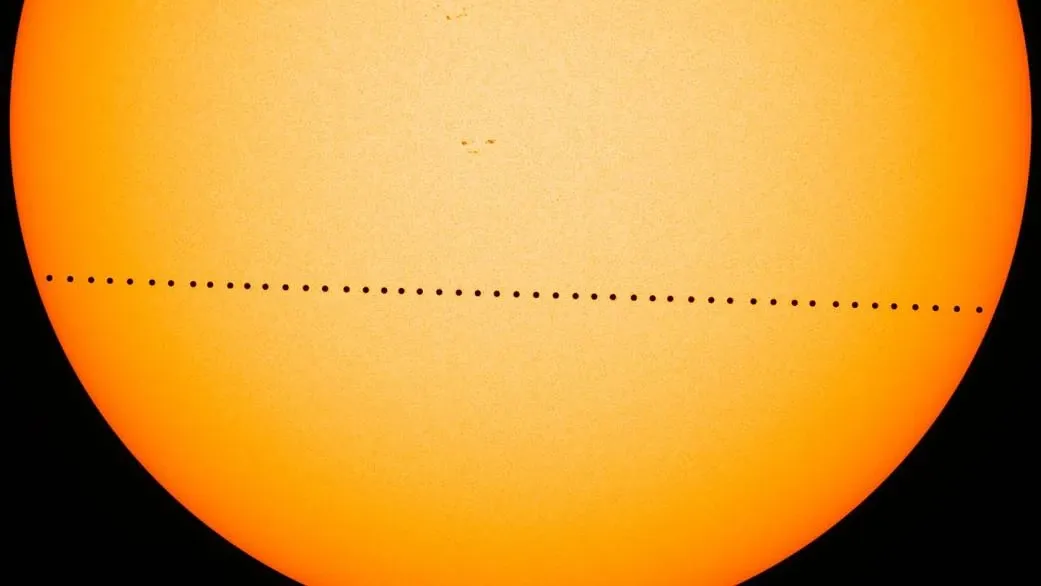
A transit offered a way in. Observers at widely separated sites looked toward Venus along slightly different lines of sight, so the planet appeared to follow different tracks across the Sun. The displacement was an example of parallax. With a known separation between observing sites, the apparent shift could help establish how far away the planet was and, through the orbital proportions, the scale of the Solar System.
There was an awkward detail. The Sun itself was not infinitely far away. Moving between observing sites changed its apparent position too. What observers saw was the displacement of Venus relative to a background that also shifted. David Stern's geometrical explanation makes that correction explicit. The two apparent shifts could not simply be treated as one.
Timing offered another route to the small displacement. In the simplified geometry of a circular solar disk, a track passing nearer its centre is longer than one nearer the edge. Observing the duration of Venus's passage helped establish its chord, the line it traced across that disk. Comparing durations from different sites could therefore reveal a difference that was difficult to measure directly as a tiny angle. Peter Bond's ESA account of the method explains this connection between separated observers and timed paths.
But a duration is only as definite as its endpoints. Better timing did not automatically supply a sharper view of where one disk ended and the other began.
A bridge without a substantial atmosphere
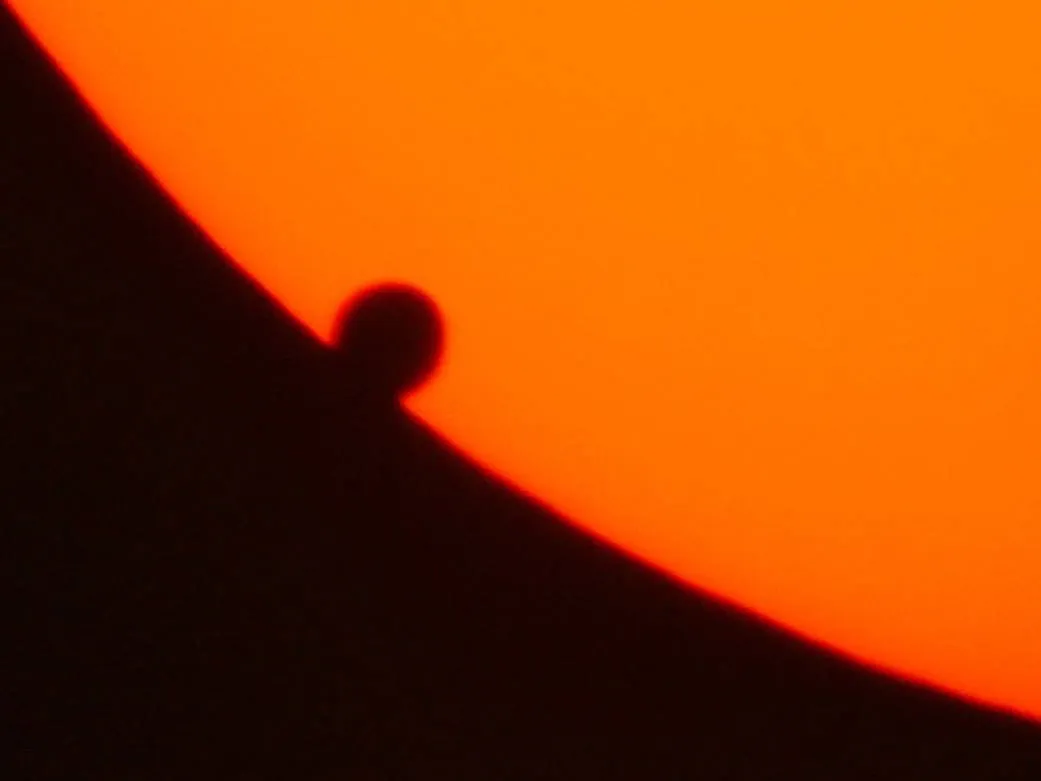
The black drop could look like something physically joining planet and Sun. It was an appearance in the image, and an atmosphere was an appealing explanation. Venus does have one. Yet a similar appearance around another planet gave researchers a way to test whether an atmosphere was required.
On 15 November 1999, Mercury crossed the Sun as NASA's TRACE spacecraft observed from orbit. Mercury has no substantial atmosphere, and TRACE was above the atmosphere of Earth. Nevertheless, a black-drop effect appeared in its white-light images near internal contact.
Astronomers Glenn Schneider, Jay Pasachoff and Leon Golub used that observation to separate two contributors. A telescope does not reproduce every point of a scene as an infinitely sharp point. Its response spreads light over a small region, blurring the boundary between bright and dark. The Sun complicates that boundary because its visible disk grows dimmer toward the edge, an effect called limb darkening.
Their modelling needed both the telescope's spreading of light and that change in solar brightness to reproduce the measured Mercury effect. Correcting for the two contributions recovered a round silhouette rather than the distorted connection at the solar limb.
Earth's atmosphere can disturb observations from the ground. Venus has atmospheric effects of its own, including an aureole of refracted sunlight. A dark bridge is not, by itself, proof that the observer has detected that atmosphere. Nor does the Mercury result erase every complication from historical Venus images.
What the picture had to preserve
The same spacecraft observed another Mercury transit in 2003. This time the images were returned in a compressed format that did not preserve enough low-intensity detail for the team to repeat its earlier analysis. The researchers had observations of the event, but the information needed for this particular correction had been damaged.
For this study, the faint brightness structure near the edge was part of the measurement. A recognizable planet crossing a recognizable Sun was insufficient. The investigators needed to know how light was distributed around the apparent contact.
By the next Venus transit in 2004, the team had included the transmission format in its observing plan. Its later account reports images obtained to those specifications and continuing analysis of the atmospheric and black-drop features. The choice made before the pictures reached Earth affected what could be asked of them afterward.
Modern Solar System distances are measured through methods including radar and spacecraft radio ranging. In 2012, the International Astronomical Union defined the astronomical unit as exactly 149,597,870,700 metres. It is a stable unit for expressing distances, including Earth's varying separation from the Sun.
An exact timestamp cannot recover a boundary that the observation has failed to preserve. Before a transit could serve as a ruler, its observers had to establish what, precisely, their images allowed them to time.