
In parts of south London, neighbouring houses could receive water from different companies. The pipes shared streets and courts, and a household's supplier might differ from the one next door. During the cholera epidemic of 1854, John Snow saw a way to turn this untidy commercial arrangement into a comparison.
One company had changed where it took water from the Thames. The other still drew from a part of the river exposed to London's sewage. If water carried cholera, people living near one another might face very different dangers through their taps.
The arrangement did not tell Snow which house belonged to which company. Before he could compare deaths, he had to discover that, sometimes from residents who had no idea themselves.
A change upstream
In 1852 the Lambeth Company moved its intake from opposite Hungerford Market to Thames Ditton. Snow described the new supply as free from London's sewage. Southwark and Vauxhall continued to take water at Battersea. The two companies' customers remained intermingled in districts south of the river.
Comparing a poor district with a wealthy one could leave many possible reasons for different mortality. Here, different supplies ran along the same streets, serving large and small houses, rich and poor residents. Snow argued that their customers shared the same immediate surroundings and social conditions, which made water source a more useful distinction than neighbourhood alone.
He had not assigned households to the companies. Earlier choices by owners or occupiers had determined subscriptions, putting different supplies into neighbouring houses for reasons unrelated to his investigation. That gave him an unusually useful comparison without giving him randomly assigned groups or establishing that every other relevant difference had vanished. His question was whether mortality would differ with water supply among people whose homes were mixed together.
Finding the company
Snow obtained addresses from the General Register Office and went to investigate the water. An address where someone died was not always the address he needed. If illness began at home and the person was moved to a workhouse or another place, he sought the supply to the house where the attack had started.
Getting even that information could be troublesome. Residents who paid water rates sometimes needed to find a receipt before naming their company. Weekly tenants often knew nothing about it because the landlord or an agent paid the bill and might live elsewhere.
Snow found another way to distinguish the supplies. At the time of his inquiry, the companies' water contained very different amounts of common salt. Adding silver nitrate produced a markedly different response. When the evidence about a supplier was unclear, he could collect water in a small phial, label it with the address and examine it at home.
The chemical test answered a question about the water's source. It was not a test that revealed cholera bacteria. Salt itself was not the cause he was investigating, and he later acknowledged that some salt reached Battersea through tidal seawater. A property that helped identify the supplier need not explain why the supply was dangerous.

He also noted the appearance of water and the times when the companies sent it into a street. These could corroborate stronger evidence, but he did not present them as substitutes for a receipt or his chemical comparison.
Others helped extend the work. John Joseph Whiting investigated several districts served only by Southwark and Vauxhall. William Farr, at the General Register Office, encouraged a wider request that registrars record the water supply associated with cholera deaths. The comparison depended on this work as well as Snow's interpretation of it.
Deaths compared with what
In the first four weeks of the epidemic, from 8 July to 5 August, the inquiry identified 334 deaths in districts reached by the two companies. In 286 cases, the house where the fatal attack occurred received Southwark and Vauxhall water. Fourteen received Lambeth water. The remainder involved other sources, including wells and water taken directly from the river, or an unknown supply.
Those counts alone do not tell us how much more dangerous one company's water appeared. A company serving more houses could have more deaths even if the danger were the same. Snow needed the size of each supply to give the numbers meaning.
A return to Parliament provided house counts for 1853. Southwark and Vauxhall supplied 40,046 houses and Lambeth 26,107. Using these denominators, Snow reported rounded rates of 71 and five deaths for every 10,000 houses during the four-week period. From those published rounded rates, he described cholera as fourteen times as fatal among the former company's customers.
These were deaths divided by supplied houses, not the percentage of individual customers who became infected. Houses could contain different numbers of people, and a record of fatal illness leaves out those who survived. The figures compare mortality relative to the number of houses served. They do not give each customer's risk of infection.
For the first seven weeks, Snow's table gives rounded rates of 315 and 37 deaths per 10,000 houses, a difference he described as between eight and nine times. The familiar fourteenfold figure belongs to the earlier period. The longer table also includes a change in method. In some districts served only by Southwark and Vauxhall, the last three weeks' supply proportions were estimated from the first four. Snow identifies those districts and explains the calculation, so the seven-week comparison should not be mistaken for a record in which every household's supply was individually established.
More than an address
Historians Howard Brody and his colleagues argue in their study of the Broad Street story that Snow's maps presented a theory and an inquiry already under way. Plotting deaths did not suddenly supply the water hypothesis. Even the famous pump intervention resists a simple before-and-after account. The handle was removed on 8 September, after the outbreak had already declined, and Snow remained uncertain how much the removal had affected its course.
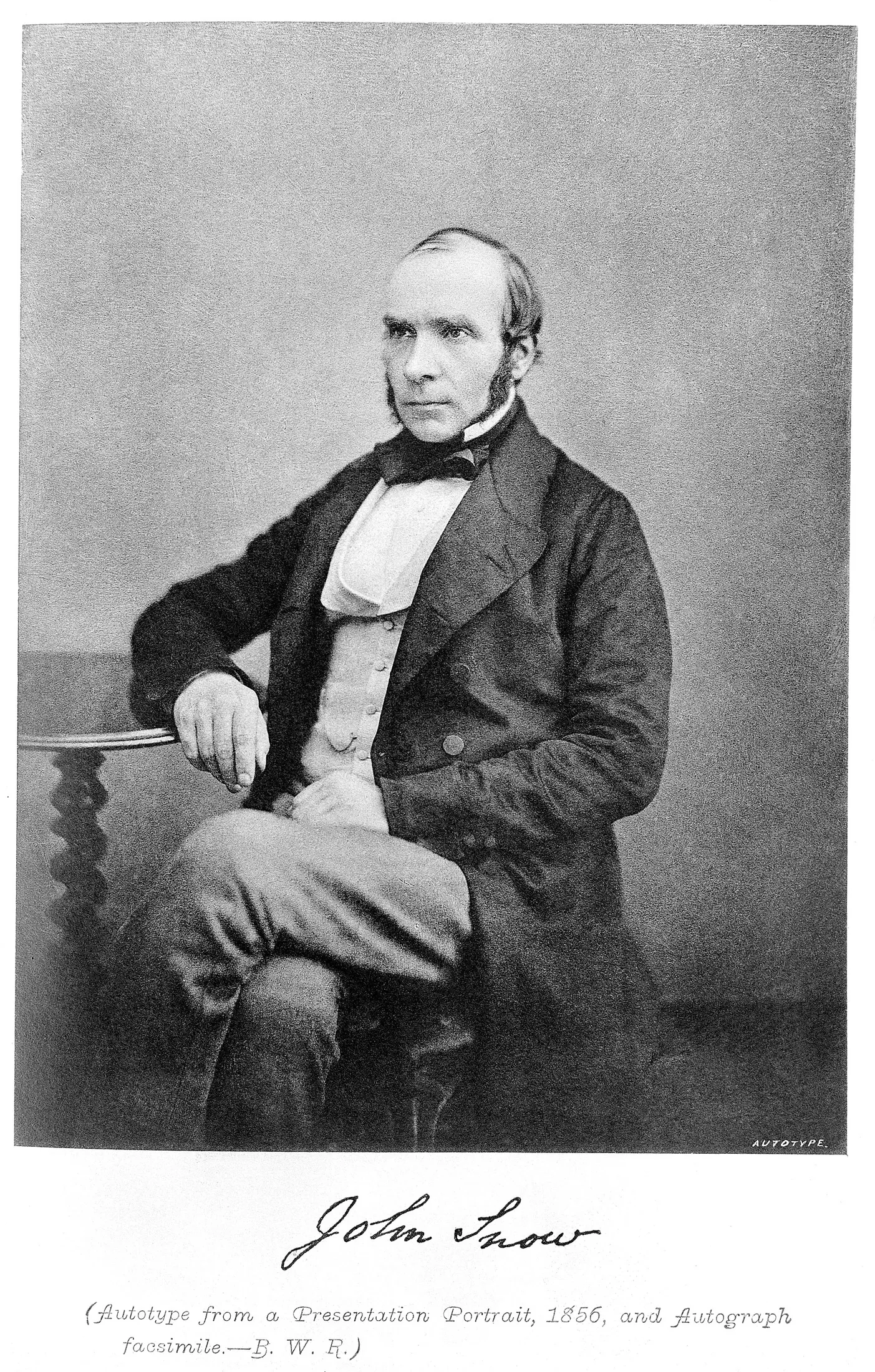
In South London, the company contrast depended on intake locations, intermingled customers and evidence about individual supplies. It did not require every Lambeth customer to escape illness or every Southwark and Vauxhall customer to die. Deaths concentrated among customers of the more polluted supply could support the comparison once its basis was stated.
Snow's 1855 book preserves the work needed to establish that basis. A name in a death return led to a house where illness had begun, which might differ from the place of death. A receipt, an inquiry to the landlord or a labelled phial could then establish which water reached it. Only when those records were related to the number of supplied houses could neighbouring addresses become a comparison of water and mortality.