

Employees east of Wallace were told to move their watches forward nine minutes. Employees west of Wallace were to move theirs back one. The instructions came from the Union Pacific Railway’s Kansas Division in November 1883, as it prepared to change the time by which trains ran.
The new times were one hour apart. East of Wallace, the division would use the time of the 90th meridian west of Greenwich, called Central time. Between Wallace and Denver, it would use the 105th meridian, called Mountain time. Different adjustments were needed because the earlier operating standards did not sit at the same distance from the new ones.
This was an agreement to make separate clocks comparable, carried out through instructions to particular people. It preceded the International Meridian Conference of 1884. It also preceded the federal Standard Time Act by more than three decades. Those events supplied different parts of the standard, rather than three competing dates for the same invention.
Setting the watches was only the beginning
General Superintendent S. T. Smith’s order of 14 November 1883 specified how the change should happen four days later. Dispatching offices would transmit the corrected time to stations. Trainmen would compare their watches at the first telegraph office they reached after the change. A train stopped for correction was not to proceed until the dispatcher gave permission.
The order also provided for time signals to be sent again each day. A common standard needed to remain common after the initial adjustment. Agreeing which hour to use would accomplish little if employees subsequently worked from watches that drifted apart without comparison.
Smith’s document is an operating instruction, not a report proving that every watch was reset correctly. Its detail nevertheless makes the task concrete. The division had to choose references, communicate them, check personal timepieces and coordinate movement during the transition.
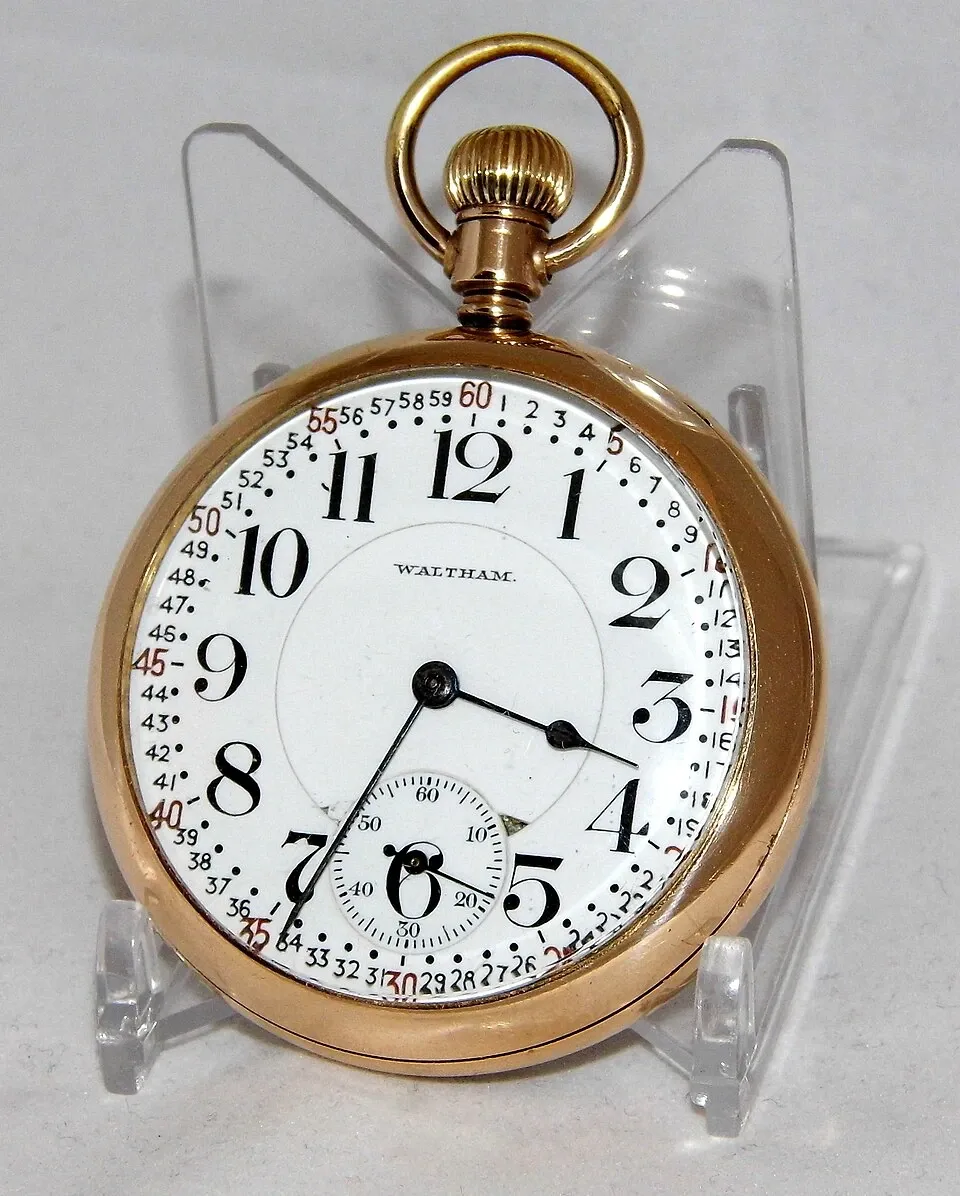
An accurate watch alone could not choose between regional conventions. It might keep the earlier operating time perfectly while differing from a watch equally well regulated to the new one. Accuracy concerns how faithfully a timepiece keeps its reference. Coordination also requires agreement about the reference itself. GPS receivers use a maintained satellite time system, although their joint calculation of clock offset and position solves a different problem from choosing regional railway times.
According to the Smithsonian’s On Time exhibition, American railroads had been operating under about fifty regional times. The adoption of Standard Railway Time on 18 November 1883 simplified that arrangement. Many communities followed the railway change, though acceptance was neither entirely immediate nor without resistance.
The Kansas Division’s change did not remove every time difference. It made the difference between two operating regions a specified hour, then told employees how to establish and maintain it.
What Washington agreed in 1884
The following year’s international conference addressed a related problem. Longitude needed a common starting point, and a time reckoning usable across countries needed an agreed reference. In Washington, delegates recommended the meridian passing through the transit instrument at Greenwich Observatory as the initial meridian for longitude.
Their Final Act, dated 22 October 1884, also proposed a universal day. It would begin at mean midnight of the initial meridian and be counted from zero to twenty-four hours.
The qualification was explicit. This universal day was proposed for purposes where it was convenient and was not to interfere with local or other standard time where those were desirable. The resolutions did not order every town to abandon its clock, nor did they enact a worldwide map of civil time zones.
That distinction matters to the familiar chronology. North American railways could already use regional standards based on Greenwich before delegates recommended Greenwich internationally. The conference supplied a common geographical and temporal reference for governments to adopt.
The proceedings also record the withdrawal of proposed resolutions about arranging local time. The delegates’ discussion treated those arrangements as something to settle locally. A common origin and a common daily timetable were separable decisions.
The law followed the working system
In a retrospective article published in December 1884, railway organizer William F. Allen anticipated legislation defining precise boundaries. His account promoted the reform, so its assessment of success should not be mistaken for an independent verdict. But the expectation itself is revealing. The system could operate while its ultimate legislative form remained ahead.
On 19 March 1918, Congress approved an act to provide standard time for the United States and to save daylight. The original statute established five zones, including a fifth for Alaska. Their reference meridians were 75, 90, 105, 120 and 150 degrees west of Greenwich.
The Interstate Commerce Commission was to define the boundaries with regard to commerce and the existing junctions and division points of common carriers. The lines were therefore not simply a geometrical exercise in cutting a map into equal strips. Their placement had to accommodate the network through which people and goods moved.
The act specified where the standard would govern. It applied to the movement of common carriers in interstate and related commerce, and to the timing of acts under federal laws, orders, rules and regulations. This added federal statutory authority to a system already used in railway operation.
Daylight saving was a separate provision within the same act. It advanced the standard time of each zone by one hour for a specified part of the year, then returned it. Choosing a regional reference and moving the seasonal clock were different rules, even though Congress addressed them together.
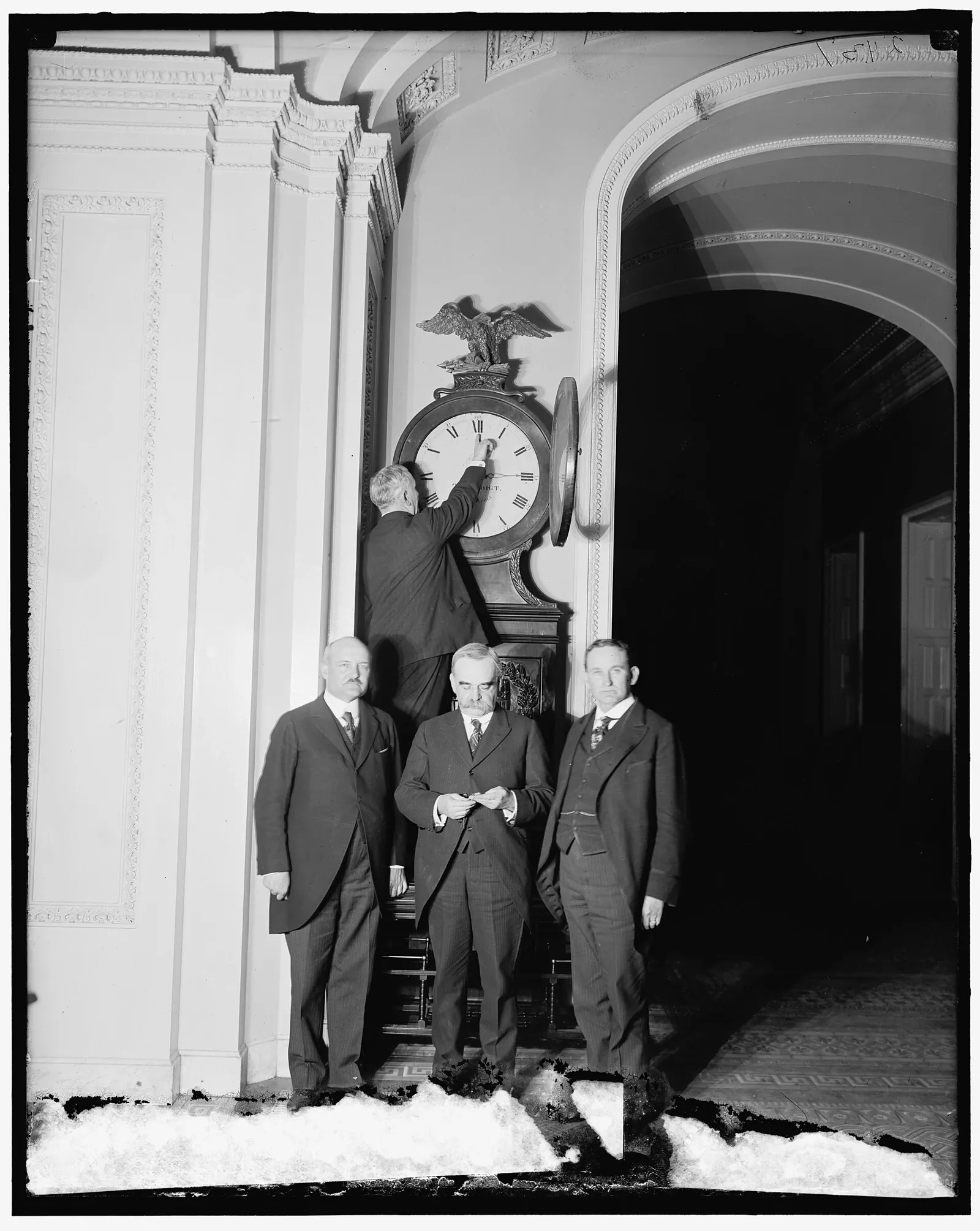
By 1918, standard time had not been waiting unused for a law to make it possible. Dispatchers had transmitted it, railway employees had compared watches against it and communities had adopted it. The statute gave federal force and a boundary-making authority to that working arrangement. The international conference had supplied another sort of agreement altogether, a common origin from which different places could reckon their times.








.jpg?ref=theroloway.org)
.jpg?ref=theroloway.org)
,_William_Saulsbury,_Jr._(DE),_and_Joseph_T._LOC_hec.13949.jpg?ref=theroloway.org)