
Working from the radio measurements returned by Philae, Wlodek Kofman and his colleagues tested the lander in 243 different positions on a computer model of 67P. For each position the signal would have taken a different path to Rosetta, the spacecraft that had brought it there. They compared the calculated travel times with the actual ones and adjusted the assumed electrical properties of the material along the way. The real Philae was still to be identified on the surface.
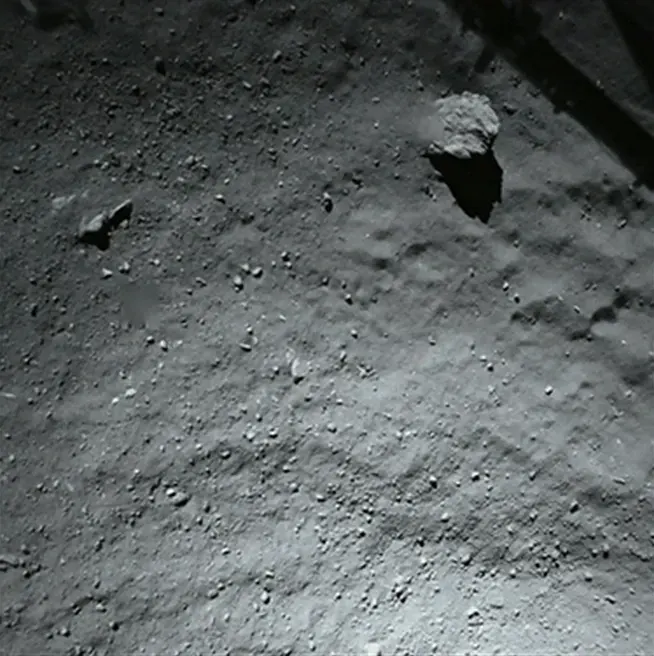
It arrived on 12 November 2014, failed to anchor and bounced into a fairly shaded, rocky spot some distance (over a km) from where it was supposed to have landed. Its instruments did continue to operate there. The images from Rosetta showed it as having very little to show indeed, just a few pixels to be itself, and the bright ice could easily be mistaken for its solar panels. The radio measurements were sufficient to constrain the search area. There was still no clear idea as to which of the small bright objects was the lander. The searchers went through the pre- and post-landing images, looking for a new object under similar illumination and viewing conditions. Something which only appeared in the post-landing images could well be exposed ice.
One of the instruments doing that was CONSERT, which had hardware on both the spacecraft. Rosetta transmitted a signal to Philae, which received it and re-transmitted it back. With part of the comet between the two spacecraft, the signal had to travel through the comet material to get to the other end. As Rosetta moved and the comet rotated beneath it, the path of the signal changed and so a sequence of measurements could be taken as the signal traversed different paths through the interior. The experiment measured the time taken for the signal to travel and the strength of the signal that came back.
During three further sets of measurements on 13 and 14 November, Rosetta and Philae were directly observable to each other. The signals travelled through space at a known speed so the times taken to get from one to the other gave distances which could be combined with Rosetta's position in its orbit. A distance from one position left a very wide range of possible lander positions, whereas distances from a number of positions constrained the area significantly. These measurements were used to refine a very rough position of the lander which had already been deduced from the signals which had passed through the comet.
Inside the comet the waves were travelling more slowly, their speed being a function of a property of the material known as permittivity. Higher permittivity meant slower wave propagation. There was also of course the matter of distance. To work out the effect of the material, you had to know how much of the wave's path was actually through the comet and how much was in the intervening free space. A position which put a greater amount of comet in the signal's path would have a different implication for the material properties of the comet in order to account for the same arrival time. Those various trial positions had to be considered in conjunction with the material which the waves would have been passing through.
The 2015 analysis gave an average permittivity of around 1.27 (empty space being 1). In conjunction with the ice, dust and other models and constraints, that led to the conclusion that 75-85% of the volume of the region sampled was empty space. That average could accommodate variations along the path of the signal. A section near the surface might have slowed the waves down more than the material further in and both of those factors would have contributed to the time recorded at the other end. The team did point out that a more precise location for Philae might be able to bring out the differences within the smaller lobe.
There was also the fact that the signals had got through at all. Valérie Ciarletti and her colleagues used that to go through various proposed subsurface configurations. In their simulations an increase in permittivity with depth would have resulted in no reception where CONSERT in fact did receive signals. They preferred a decrease with depth in a 2015 paper, though the precise profile was still very loosely constrained.
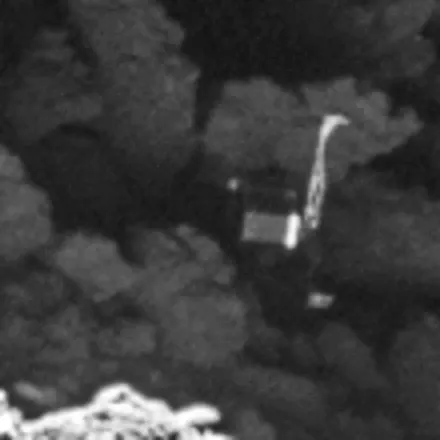
Evidence from the search increasingly pointed to one object. On 2 September 2016 Rosetta imaged the area from about 2.7km away, close enough to be able to make out the body of Philae and two of its legs in a dark crack. Each pixel was about 5cm on the ground. The image got to Earth two days later and ESA announced the identification on 5 September. This confirmed the favoured candidate within the area predicted by CONSERT and its orientation was in very good agreement with the earlier reconstructions. The search team therefore concluded that Philae had not moved significantly since landing and the recovered position could be used for the 2014 measurements.
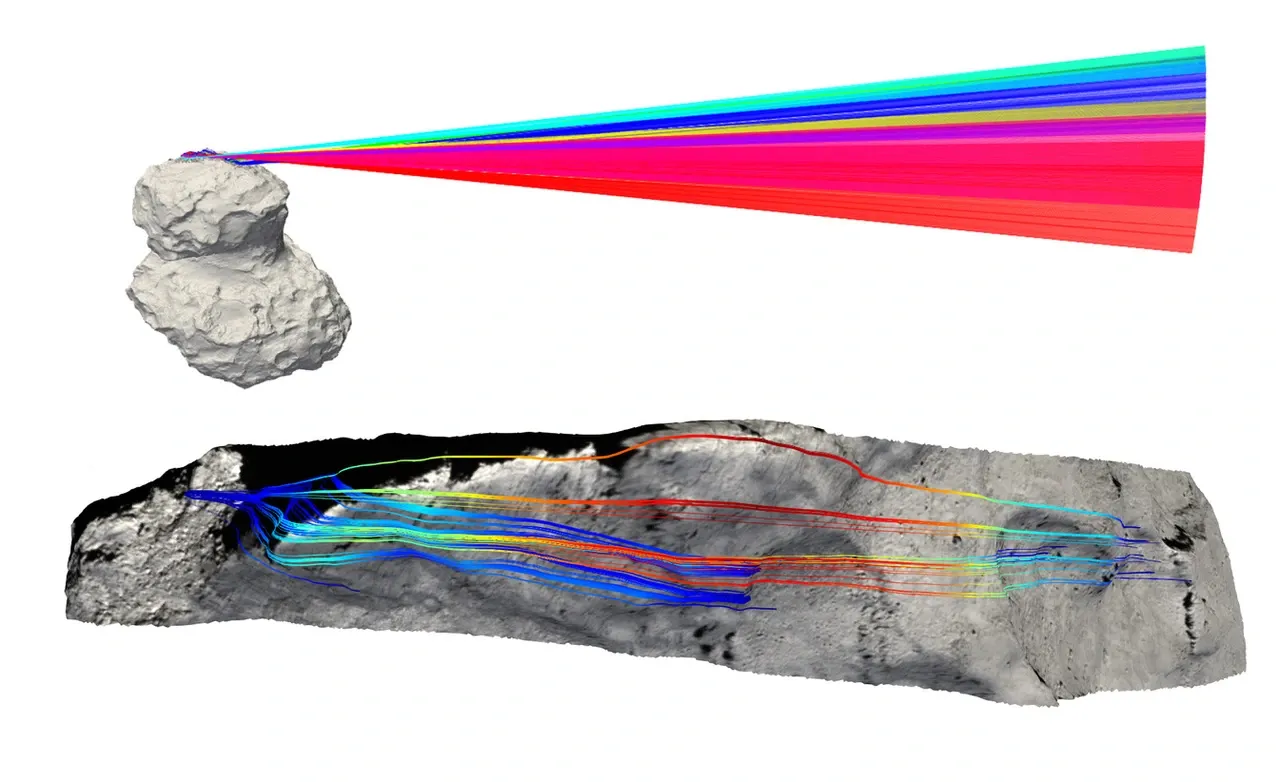
The computer's Philae was the one that had to move. The radio waves bend as they pass through the surface so the topography of the ground was important in reconstructing the paths of the waves. For the 2020 reanalysis Kofman's team placed Philae on an improved 3D model 13m from the published position, picking a point that corresponded to the actual local slopes and allowed for differences between the various terrain models and coordinate systems.
They went back to the 2014 travel times to re-construct the path lengths and depths below the nearest surface (omitting the signal strengths as the immediate surroundings of the antenna were still not well enough known). A long journey through the material could still be quite close to the outside. Their model had the sampled material as a shallow region and a deeper region. In the best fit the shallows had the higher permittivity.
The outer material has been subject to processes which could alter its electrical properties. As a comet orbits the Sun, it is heated and material is driven off the surface, some of which then falls back. Deposits can build up on ground which will be exposed again on subsequent passes. Such activity could lead to a more compact outer layer around a more porous inner layer. A change in the ratio of dust to ice could also have an effect on the permittivity, so the difference in the radio results allowed for a number of possible physical interpretations.
In that two-region model the best fit gave the shallows a permittivity of around 1.7-1.95 and 1.2-1.32 further in, with the characteristic change occurring at around 14-25m below the surface in that part of the smaller lobe. A gradual transition was still possible within the two-region model. The deeper region was very close to the average value reported in 2015, now with a different value for the material in the outer region.
Sources
- Wlodek Kofman et al. (2015). Properties of the 67P/Churyumov-Gerasimenko interior revealed by CONSERT radar. Science 349, aab0639.
- Laurence O’Rourke et al. (2019). The search campaign to identify and image the Philae Lander on the surface of comet 67P/Churyumov-Gerasimenko. Acta Astronautica 157, 199–214.
- Max Planck Institute for Solar System Research. CONSERT instrument overview. Principle of the measurements.
- Valérie Ciarletti et al. (2015). CONSERT suggests a change in local properties of 67P/Churyumov-Gerasimenko's nucleus at depth. Astronomy & Astrophysics 583, A40.
- European Space Agency (2016). Philae found!.
- Wlodek Kofman et al. (2020). The interior of Comet 67P/C–G; revisiting CONSERT results with the exact position of the Philae lander. Monthly Notices of the Royal Astronomical Society 497, 2616–2622.
- European Space Agency (2020). Rainbow comet with a heart of sponge.
- Alain Hérique et al. (2015). Philae localization from CONSERT/Rosetta measurement. Planetary and Space Science 117, 475–484.