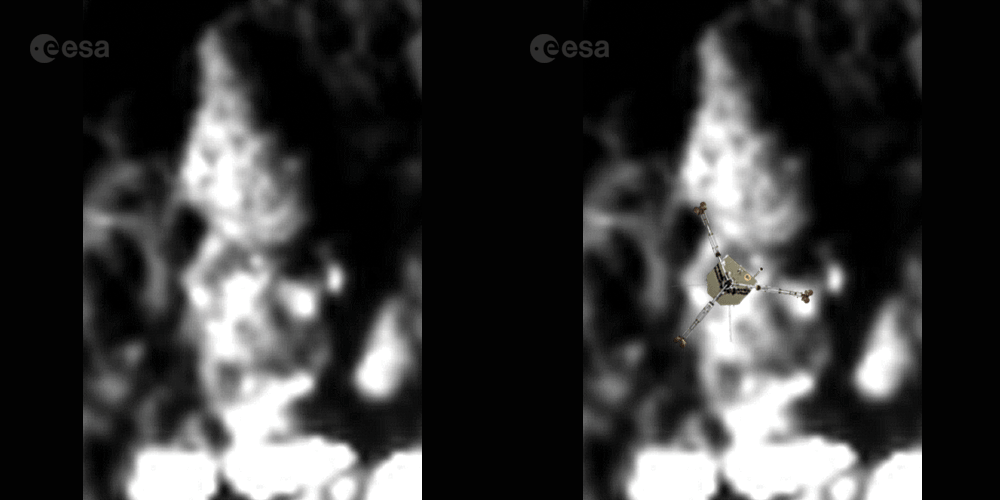
During the hunt for Philae, the lander which had bounced across 67P and gone missing, ESA scientist Laurence O'Rourke spotted a very bright patch in the images. It was in a crevice between two boulders and had a very angular appearance. The team would go on to compare that with the lander's upper surface. One of the depressions appeared to be a match for the projecting housing of the drill.
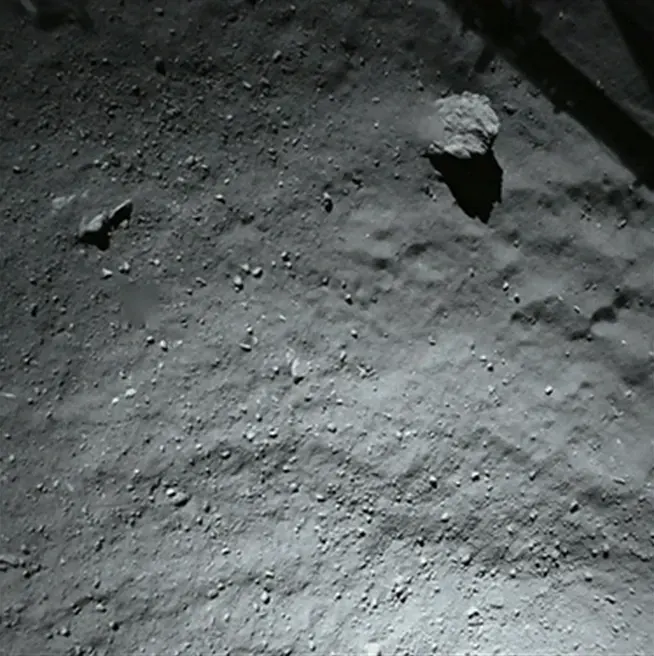
Philae arrived on 12 November 2014 with harpoons intended to secure it. The harpoons didn't fire and after touchdown at Agilkia it bounced, hit a cliff edge and went on to cross the comet before eventually coming to rest beneath an overhang at Abydos. There were some changes in its motion during an intermediate encounter (termed touchdown two) which were recorded by the instruments. O'Rourke and team ultimately assigned four separate contacts to that encounter, spread over just under two minutes. The crevice in question was some 30m from the final resting place.
By September 2016 Rosetta was close enough for its camera to resolve the lander's body and legs. The same image showed the edge of the putative impression. By comparing the known features around the crease in the pre- and post-landing images, they were able to identify a number of smaller areas that had changed. Some of the boulders in the region had moved and they considered the possibility of a different boulder having hit and created the features. Found no characteristic debris of such an impact. Two of the edges in the exposed icy material were about 60cm, corresponding to parts of the upper platform of Philae.
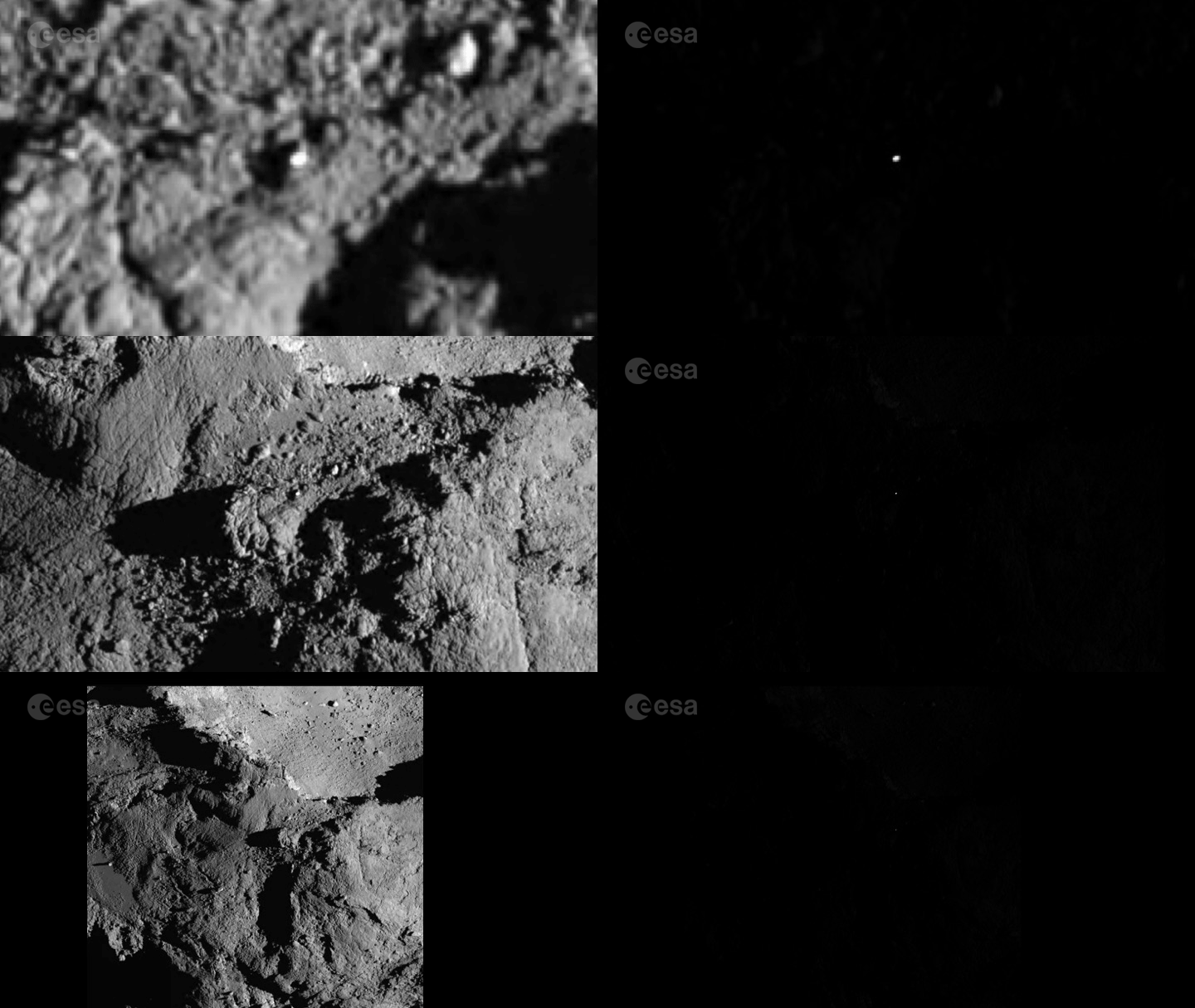
Water ice can lose the shape of an accident without ever making a puddle. It can be exposed to sunlight and simply go straight from ice to vapour, slowly eroding the impression (though a good deal of the crevice was in fact sheltered). The authors' calculation of ice loss did suggest a greater degree of widening than the images actually showed. They still went on to use the fit to the dimensions of Philae as an indicator that the amount of erosion had been quite modest over the nearly two years between the encounter and this image.
The mark itself was judged essentially unchanged and the photograph of the lander resting at Abydos became a kind of measuring device. Edge on it looked to be about 25cm deep. Other views gave a minimum area of around 0.22m2 with part of the mark still hidden. Depth x area gives a displaced volume of at least 0.054m3. To work out the resistance of the material they needed to work out how much of Philae's energy had gone into compressing it.
The motion required for the energy estimate could be partially reconstructed from ROMAP (the instrument sent to look at the magnetic field). The boom which held the sensor 48cm from Philae was mounted on springs and was able to move relative to the body of the spacecraft, translating the sensor through the spacecraft's own magnetic field. That movement produced a very distinct signature in the record. By comparing that signature with the data from Rosetta's magnetometer, you could separate out the changes in the ambient field from those which were due to the lander itself.
In their reconstruction Philae lay on its side and went through the boulders, its legs rotating through the material in a curved crevice some 2.5m long. As it approached the end of the crevice, the upper surface of the lander was pressing into the ice/dust mix within a boulder before rotating out again. The movement of the boom indicated the compression lasted about three seconds. Both magnetometers were sampling at one Hz so there's very little detail available for such a short, messy event.
The instrument record also allowed them to work out the time intervals between individual contacts. Dividing the distances measured in the images by those time intervals gave them an estimate of speed. The lander was also rotating and that rotation was factored into their energy calculation (they inferred the amount of rotation out of the crevice, whose magnetic signature was masked by the boom motion). The comparison of the energy before and after the compression gave them the loss of around two thirds of a joule which was the figure they reported in their Nature paper from October 2020.
For a simple compression with the resisting pressure taken as constant, the work done is simply the pressure times the volume displaced. Dividing the reconstructed energy loss by that minimum volume gave an upper bound estimate of about 12 Pa for the compressive strength of the material (i.e. its resistance to being crushed). More material could have been affected beyond the visible impression; the energy would have been spread over a larger volume and the estimate would have been lower.
A boulder as weak as the calculation suggested was hard to envisage. The energy loss on impact wouldn't tell you anything about its original porosity (the proportion of empty space). They'd modelled an interior of clumps of dust and ice with voids between them. The clumps themselves weren't completely solid either, having their own voids. If the clumps took up 55% of the available volume and solid material made up 46% of each clump, then solid material would occupy about a quarter of the whole. That gave the 75% porosity figure.
In a 2022 assessment Jens Biele, Jean-Baptiste Vincent and Jörg Knollenberg cast doubt on the attribution of the marks and the dimensions used to calculate strength. Vincent had been part of the original study. They were happy to accept that one boulder might be very weak, but were sceptical as to how general a result that would be. The discussion also drew on the acoustic observations at Abydos (the final resting place some 30m away) which suggested the material there was in fact firmer.
O'Rourke and co continued to defend the estimate in a 2023 conference contribution. They have also cast doubt on the contact arrangement of MUPUS (the hammering probe whose hammer strokes were used in the acoustic experiment) from a rather pixelated image which suggests that the hammer head may have been sitting part way on a lander leg and that this could have had an effect on the result. That's with respect to the acoustic comparison; the argument over the origin and size of the marks remains unaltered.
Their sampling proposal was for quite soft, dusty ground. If a subsequent mission came across material that gave as expected, then they proposed a tube could be pushed in to sample successive layers without the need for a drill.
Sources
- Laurence O’Rourke et al. The Philae lander reveals low-strength primitive ice inside cometary boulders. Nature 586, 697–701 (2020). Open manuscript · Supplementary information.
- ESA. Philae’s second touchdown site discovered at ‘skull-top’ ridge. 28 October 2020.
- ESA. How Philae left its mark during touchdown two. Reconstruction and caption.
- ESA. Philae found!. 5 September 2016.
- Jens Biele, Jean-Baptiste Vincent and Jörg Knollenberg. Mechanical Properties of Cometary Surfaces. Universe 8(9), 487 (2022), especially §4.2.1.
- Laurence O’Rourke, Jürgen Blum, Philip Heinisch and Bastian Gundlach. Why drill if a Comet’s surface and sub-surface is super soft?. Asteroids, Comets, Meteors 2023, contribution 2335. Conference poster.